Know where you stand before you decide
Anunta's VDI Migration Complexity Tool walks you through the key questions in about five minutes and maps your environment profile to the platforms most likely to fit.


I spend a lot of time talking to IT directors and VPs who are trying to make sense of what is happening in the virtual desktop space right now. To be fair, is a lot to keep track of. The platform landscape shifted. Hardware costs jumped in ways nobody fully anticipated. AI at the desktop layer went from a future-state conversation to something vendors are shipping. And renewal conversations are happening in the middle of all of it.
This post is my attempt to pull the threads together in one place. Not to tell you which platform to choose -- that depends entirely on your environment -- but to give you a clear picture of where things stand in 2026 and what your peers are wrestling with. If something here is useful for a conversation with your CFO or CISO, even better.
VDI is getting more complicated, more crowded, and in some ways more compelling than it has been in years. The organizations navigating it well right now are the ones who stepped back from the noise and made deliberate decisions rather than reactive ones.
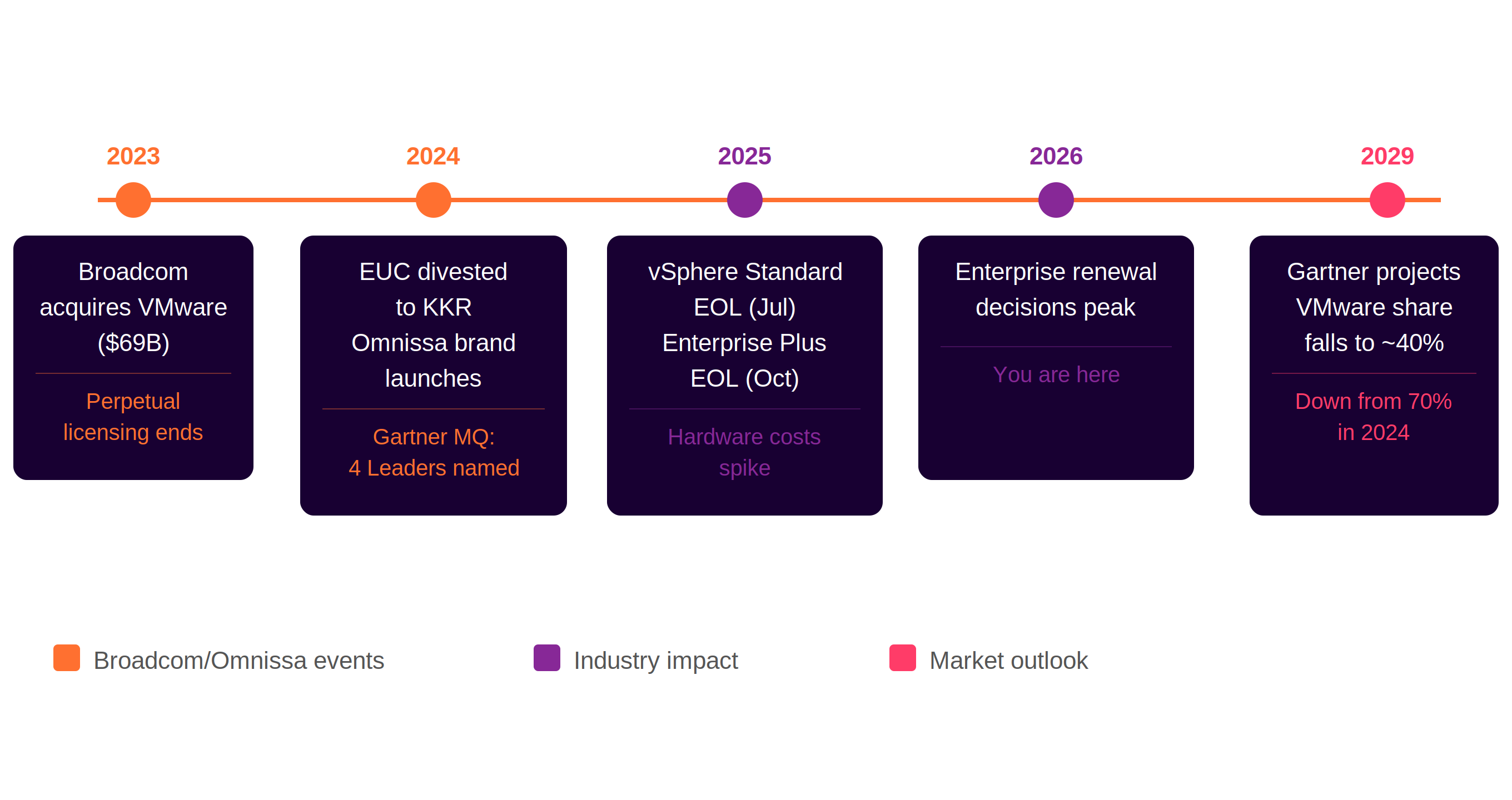
The VDI and DaaS vendor landscape is in the middle of a reshuffling that is not finished yet. Here is where things stand as of mid-2026.
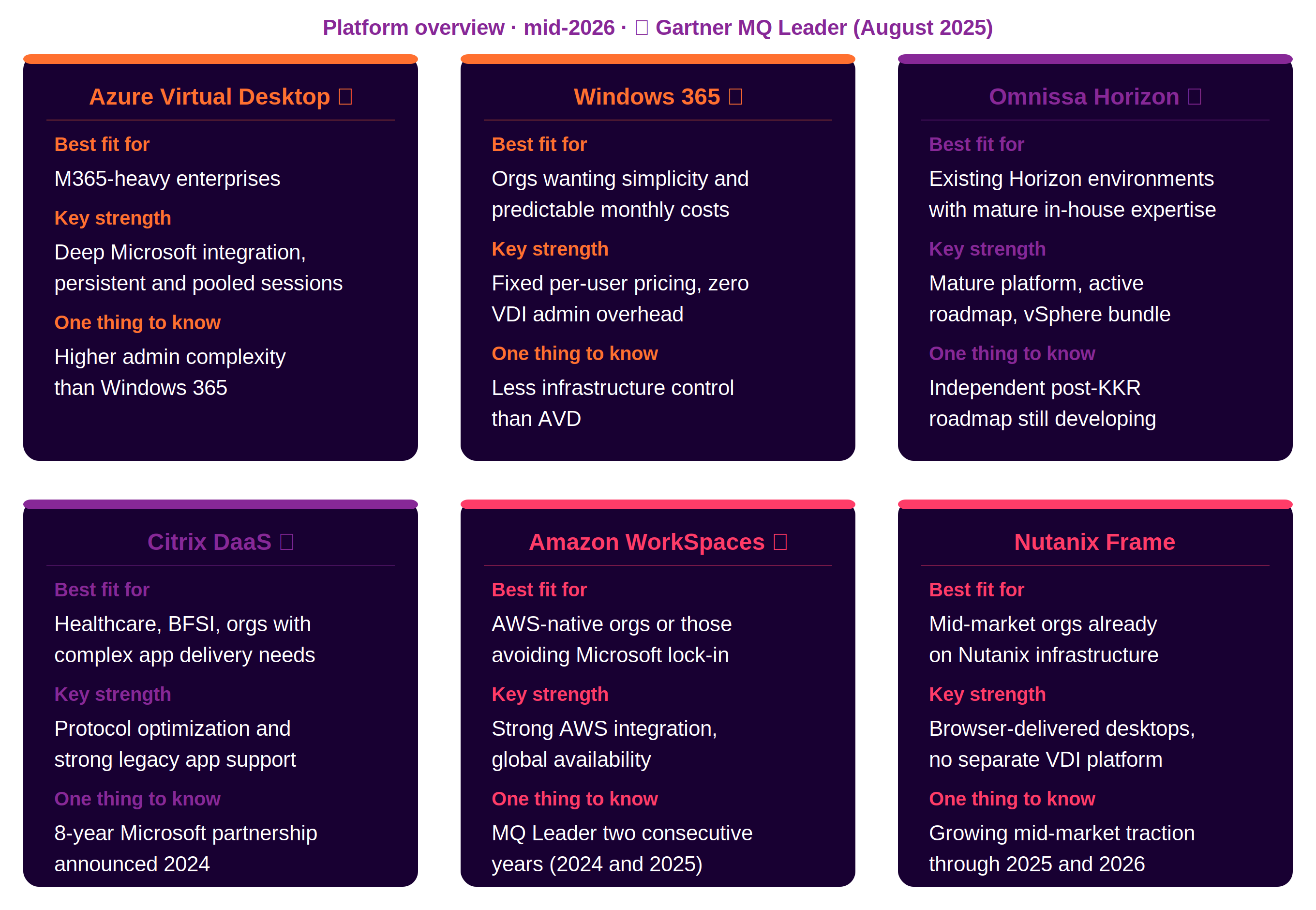
 The August 2025 Gartner Magic Quadrant for DaaS placed Microsoft, AWS, Omnissa, and Citrix all in the Leaders quadrant. That is a meaningful data point: four vendors with genuinely differentiated approaches are considered leaders, which tells you something about how much the market has matured. A 2026 edition is expected this summer -- we will update this post when it publishes.
Microsoft is the most active platform in terms of new deployments, largely because Azure Virtual Desktop integrates naturally into environments already running M365. Windows 365 is the simpler, fixed-cost version aimed at organizations that want cloud-delivered desktops without the infrastructure management overhead.
Omnissa (formerly VMware Horizon, now independently owned by KKR following Broadcom's divestiture of the EUC business) has stabilized its licensing model and is actively investing in its roadmap. For organizations with mature Horizon environments and deep in-house expertise, Omnissa continuity is a well-supported path. TechTarget's coverage of the transition is worth reading if you want the full picture of what changed and what did not.
Citrix DaaS Citrix DaaS remains a strong option for organizations with complex application delivery requirements, particularly those who've built deep Citrix expertise in healthcare or financial services environments. Citrix also announced an eight-year strategic partnership with Microsoft in 2024, which matters for long-term platform planning.
Amazon WorkSpaces is the natural landing spot for AWS-heavy organizations or those who want to avoid concentration in the Microsoft ecosystem. AWS was named a Leader in the Gartner MQ for the second consecutive year in 2025.
Nutanix Frame is gaining traction in mid-market organizations already running Nutanix infrastructure, offering browser-delivered desktops without requiring a separate VDI platform.
The key thing to flag here: none of these platforms is objectively better than the others. Each one fits a profile of organizations well. The question is which one fits yours.
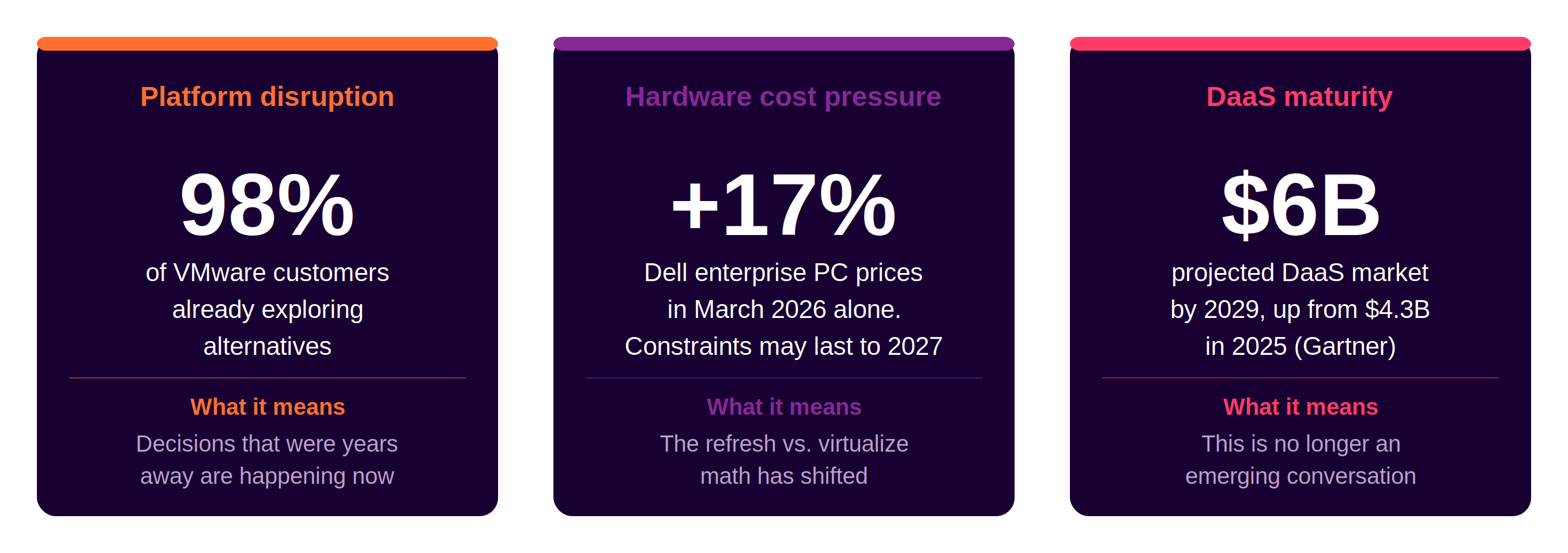
Beyond the platform landscape, three things are happening simultaneously that are changing the math for a lot of organizations.
According to a Rimini Street survey of 111 global VMware customers conducted in late 2024, 98% are already using, planning to use, or considering alternatives to their VMware environment, and 36% have already made a move. Gartner has projected that VMware's overall market share will fall from 70% in 2024 to around 40% by 2029.
What is most useful to understand here is that this is not a uniform exodus. As Network World reported, large enterprises are being deliberate. The responsible question is not "which platform do we move to?" It is "what is the cost of staying, what is the cost of moving, and does our long-term cloud roadmap change the answer?" The organizations rushing past those questions are the ones showing up in the cautionary tales.
For IT teams with Horizon environments: Omnissa is a legitimate and well-supported platform with an active development roadmap. The decision to stay or migrate should be driven by your environment's needs, your team's expertise, and your renewal economics -- not by the noise in the market.
This one snuck up on a lot of IT budgets. The combination of AI-driven memory demand, component shortages, and tariffs on imported hardware has pushed enterprise PC prices up significantly in 2026. Computerworld reported in January 2026 that the PC market is "shaping up to be extremely volatile," with IDC and Gartner attributing the price shock to structural supply constraints that may persist into 2027. Dell implemented price increases of 15 to 20% in late 2025, followed by a further 17% in March 2026. Lenovo cancelled outstanding quotes and repriced entirely from January 2026.
For organizations on a 3 to 5 year refresh cycle, the math on virtualization looks meaningfully different today than it did 18 months ago. We put together a detailed look at how to think through hardware lifecycle decisions under these conditions -- Designing Hardware Lifecycle Under Constraint is worth a read if your refresh is coming up in the next 12 to 18 months.
This is not a new conversation -- DaaS has been a viable option for mature organizations for several years now. What has changed is the breadth of adoption and the economics. The 2025 Gartner Magic Quadrant for DaaS noted that DaaS is now deployed in most organizations, though typically for a subset of employees. Gartner projects DaaS spending will grow from $4.3 billion in 2025 to $6.0 billion by 2029, and that by 2027 virtual desktops will be cost-effective for 95% of workers.
The shift is being driven by predictable monthly costs that are easier to budget than capital refresh cycles, reduced on-premises infrastructure overhead, and the ability to scale without hardware procurement lead times. For organizations with a significant remote or hybrid workforce, the operational case is well established. The nuance is in understanding what you give up in terms of infrastructure control, and whether that tradeoff is acceptable for your compliance and security requirements.
Based on what we are seeing and hearing across the industry, here are the real conversations happening in IT right now.
Stay vs. migrate vs. hybrid. Most large enterprises are not landing cleanly in a single-platform model. A workable Phase 1 for many organizations looks like pooled non-persistent desktops for the office worker majority, a persistent cloud PC option for power users who need them, and a thin client refresh rather than a full laptop refresh for the endpoints. For organizations specifically navigating a Citrix transition, we put together A Practical Field Guide to Citrix Migrations that covers the most common paths, tradeoffs by role, and what a good/better/best prioritization looks like in practice.
How to build a business case. The technology decision and the finance conversation are two different things. The questions your CFO will ask -- what is the 3-year total cost including subscriptions, implementation, and ongoing support? -- require different inputs than the questions your infrastructure team is asking. Gartner estimates migration services alone can range from $300 to $3,000 per VM depending on complexity, and that range has to show up as a range in the business case, not a single optimistic number. We are working on a structured business case template to help IT teams build that case (watch this space).
Who owns Day 2. This is the question that gets answered too late in too many migrations. Ongoing operational support, who handles it, at what SLA, and at what cost, shapes platform selection more than most organizations realize until they are mid-project.
By now you have heard more about agentic AI than you probably wanted to. The conversation has dominated the industry for the better part of a year, and most IT leaders have a reasonable handle on what it is. What is less settled is what it actually means for the virtual desktop infrastructure you are running or planning to run.
The practical questions are starting to come into focus. Microsoft has already released a public preview of Windows 365 for Agents, and other VDI and DaaS vendors are following. An AI agent operating inside a virtual desktop session has different data residency, audit, and access control implications than a user doing the same tasks. The architecture decisions you make now about session isolation, logging, and identity governance will determine how much retrofit work you face when agentic workloads arrive in your environment -- and at this point, it is a question of when, not if.
Anunta's recent post on agentic AI and the desktop layer covers the infrastructure implications in more depth if you want to move past the concept and into what it means for your environment specifically. Anunta's AI Fabric platform is built to surface and govern agent activity across managed VDI environments, which becomes operationally relevant the moment Windows 365 for Agents or Microsoft Agent 365 hits your fleet.
The 2026 Gartner Magic Quadrant for DaaS. Expected this summer. Given how much has shifted in the platform landscape since August 2025, this edition will be worth reading closely. We will link to it here when it publishes.
Omnissa's roadmap cadence. As an independent company now nearly two years post-divestiture, Omnissa's product development and partner ecosystem will tell you a lot about the long-term viability of Horizon as a platform. The first phase was stabilization. The next phase is growth, and it will be visible in the roadmap.
Hardware cost relief timeline. Both Gartner and IDC have flagged that supply constraints may persist into 2027. If you have a refresh cycle coming up in the next 18 months, the timing of that procurement decision matters more than it normally would.
Secure enterprise browsers as a complement to VDI. Vendors including Island and others are gaining traction in regulated industries as a potential complement to -- and in some cases an alternative to -- traditional VDI for specific use cases. The boundaries of where a secure enterprise browser replaces versus supplements a virtual desktop are still being worked out, but it is worth tracking if you are evaluating your broader access architecture.
Data residency in cloud desktop sessions. As more organizations move workloads to cloud-delivered desktops, the question of where data actually resides during a session is getting more attention from legal and compliance teams. Expect this to be a more prominent part of platform evaluation conversations in the second half of the year, particularly in healthcare and financial services.
The VDI market in 2026 is not chaotic -- it is clarifying. The platforms are maturing, the economics are shifting, and the operational questions are getting more concrete. What makes this moment genuinely tricky is that three significant forces are landing at the same time: a platform vendor reshuffling that forced decisions onto roadmaps that were not ready for them, hardware cost pressure that changed the refresh math, and a DaaS market that has quietly become the default rather than the exception. Organizations that navigate this well will be the ones who took the time to understand their own environment before reaching for a platform answer. The ones who struggle will be the ones who let renewal pressure or vendor noise make the decision for them.
.png?width=7000&height=3938&name=Anunta%20Blog%20Banner%20(7).png)