Get More Perspectives on Gartner Digital Workspace
Read Anunta's key takeaways from the Gartner Digital Workplace Summit in March 2026— including what leading organizations are doing differently right now.
.png?width=2240&height=1260&name=Change-management-framework-digital-workspaces%20(1).png)

It shows up the same way, every time: a platform gets deployed, the metrics look fine, and six months later HR is complaining, employees have built workarounds, and IT is fielding tickets nobody budgeted for. Digital workspace initiatives stall out because the organization never agreed on what success actually looks like and who's accountable when it doesn't happen.
The cost of getting this wrong is staggering. Gallup's 2025 State of the Global Workplace report found that low employee engagement cost the global economy $438 billion in lost productivity in 2024 alone — and only 21% of employees worldwide consider themselves truly engaged at work, the lowest level in a decade. Those aren't engagement problems in isolation. They're downstream symptoms of workplaces that are technically functional but operationally misaligned.
This blog is a result of seeing operational misalignment happen in workspaces across North America and the globe in real time. We've learned from countless implementations that organizations making real progress aren't starting with better tools. They're starting with a clearer way of working together.
Jacci Robinson took what she observed in real time with her real-world change management experience and set out to make a concrete framework that moves digital workspace from a project mentality to an operating model. She debuted it this year at Gartner Digital Workspace. Here's what it looks like — and why it matters for leaders who are tired of relitigating the same decisions.
The concept is simple: instead of attempting to improve the entire digital workspace simultaneously, identify five to seven specific moments where friction is genuinely unacceptable — and make those your filter for every decision.
Day-one onboarding. Secure access during an active incident. Cross-team collaboration during a merger. These are experience anchors.
The failure pattern they fix: Most organizations try to improve everything at once, which means they effectively improve nothing. Resources scatter. Priorities conflict. Six months in, the initiative looks stalled because there's no shared definition of what "better" actually means.
What the research says: Gartner found that only 23% of digital workers report being completely satisfied with their work applications, down from 30% in 2022. That's not a sign that all applications are failing. It's a sign that the wrong experiences are being prioritized, or that no one has explicitly named which experiences matter most.
Where it breaks down in the real world: The financial cost of getting onboarding wrong alone is significant. LumApps has documented that Amazon lost approximately $678 million over two years due to inadequate onboarding practices, and Salesforce reportedly experienced $35 million in productivity losses from a 5-day onboarding program. These aren't small companies failing at basic HR. They're organizations with enormous technology investments that hadn't agreed on which experience outcome actually mattered on day one.
The HR challenge here is real. According to Gallup, only 1 in 8 employees strongly agree their organization delivers an excellent onboarding experience and a 2024 survey by NetSuite found that 33% of employees report poor onboarding experiences across the U.S., UK, and Australia. The problem isn't that HR doesn't care. It's that nobody has handed HR a clear target. When onboarding isn't named as an experience anchor, explicitly, with shared ownership, IT measures account creation speed, HR measures paperwork completion, and neither team is measuring whether the new hire can actually do their job by Friday.
The shift: When this manufacturer made onboarding their first experience anchor, they defined success in one sentence: "A new hire is productive on day one." That single sentence changed what HR cared about (device readiness, not just paperwork), what security automated (compliance verification, not manual review), and how IT was measured (time to productive access, not ticket closure rate). Onboarding time dropped from two days to four hours, but what mattered more was that three functions finally agreed on what "done" looked like.
In most regulated organizations, ownership of digital workspace is fragmented by design. IT owns the tools. Security owns the controls. HR owns the lifecycle. Operations owns the outcomes. That fragmentation isn't a flaw to be fixed, it's a reality to be managed.
The Shared Ownership Model doesn't try to eliminate fragmentation. It makes ownership explicit and creates a structure that forces tradeoff decisions to happen in the room, not by default.
The failure pattern it fixes: When accountability is unclear, governance becomes theater. Teams hold meetings that look like decision forums but function as update sessions. The same tradeoffs: security control vs. employee productivity, consistency vs. local flexibility, gets relitigated in four different meetings across three different quarters because nobody was ever authorized to resolve it.
What the research says: A Gartner survey of more than 2,400 CIOs found that when CIOs co-lead, co-deliver, and co-govern digital initiatives with business counterparts, 63% of digital initiatives meet or exceed their targets. In organizations where IT retains traditional, siloed control, that success rate drops to 43%. That 20-point gap is the cost of unclear shared ownership, made measurable.
Where it breaks down in the real world: The Digital Workplace Group's independent research on enterprise digital environments consistently finds that strong cross-functional management, across IT, HR, internal communications, and business leadership, is one of the primary differentiators between organizations that make digital workplace progress and those that stay stuck. But more telling is what they observe when governance is absent: "many large organizations have unclear ownership of digital workplace programs because these programs don't fit neatly into traditional operational divisions."
The shadow IT problem is a direct symptom of this. According to JumpCloud, 41% of enterprise employees were using technology outside of IT oversight in 2023. And as ISACA's research makes clear, shadow IT is fundamentally a governance failure, not a user behavior problem. When employees build workarounds, they're not being reckless, they're filling a vacuum left by unclear ownership. The tools IT provides don't meet their needs, and there's no clear channel to resolve it, so they solve it themselves. In regulated environments, that workaround becomes a compliance risk.
The shift: A standing digital workspace decision council changes this if it operates as a decision forum, not a coordination meeting. The distinction matters. A coordination council shares information. A decision council resolves tradeoffs. As Reworked reports, senior VP of digital workplace product management at Northern Trust Susan Cummings describes the requirement clearly: the roundtable must include product, engineering, design, security, risk, compliance, and data protection, each aligned to a deliverable, not just present in the room.
Most IT teams measure what they can control. Ticket volume. System uptime. Account creation SLA. These metrics are real, trackable, and completely meaningless to an HR leader, a COO, or a business unit head trying to justify a budget.
Translation Metrics are the bridge. They reframe technical signals as human outcomes and they do something more important than inform. They make tradeoffs legible across functions.
The failure pattern they fix: When metrics can't be explained without IT translation, they can't drive cross-functional decisions. Security justifies a control based on compliance rate; the business feels the friction but has no number to push back with. The tradeoff never becomes explicit, so the control stays, the friction persists, and someone in operations eventually builds a workaround.
What the research says: McKinsey identifies process friction, lack of accountability, and unnecessary complexity as the three primary "drag factors" preventing organizations from capturing productivity gains, even when underlying technology is sound. The problem isn't the technology. It's that the measurements don't connect what IT is doing to what the business is experiencing.
Real-world KPI translation in action: The move from technical metrics to human outcomes isn't theoretical, organizations across industries have made this shift and documented the results. Consider these translations:
Gartner recommends that digital workplace leaders assign hub owners who set objectives and identify success metrics that align with employee experience strategy — not just IT roadmaps. That's the institutional version of translation: building the reframe into how accountability is structured from the start.
The test: If you showed your current digital workspace metrics to your CHRO or COO without explanation, could they tell you what was working and what wasn't? If not, the metrics aren't traveling and neither is the business case for digital workspace investment.
Most digital workspace frustration doesn't come from genuine disagreement about priorities. It comes from unclear authority over tradeoffs. When nobody knows who decides whether a security control should flex for a productivity need or a policy should hold regardless of the business impact, decisions either stall or default to whoever escalates loudest.
The failure pattern it fixes: Recurring debates. The same policy conflict surfaces in Q1, gets tabled, resurfaces in Q3, gets escalated, and lands in the same inconclusive meeting it did six months ago. The reason isn't organizational dysfunction, it's that decision rights were never documented.
What the research says: Gartner defines governance as the specification of decision rights and an accountability framework and notes that programs which approach governance as a control mechanism rather than a business capability rarely succeed because stakeholders disengage when the work isn't tied to shared outcomes. That's precisely what happens when the digital workspace council becomes a status update meeting: the business stops showing up, IT stops getting buy-in, and both sides feel like the process isn't working.
Where it breaks down in the real world: The security-vs-productivity tension is the most common decision rights failure in regulated environments. Research published in PMC found that the primary driver of non-malicious security policy violations by employees is conflict between security policy compliance and timely work completion. In plain terms: when security controls get in the way of getting work done, employees bypass them, not out of malice, but out of necessity. That's not a training problem. It's a decision rights problem. Nobody ever made an explicit, documented call about where the security control ends and the employee's legitimate productivity need begins.
Reworked's reporting on digital workplace governance quotes Alfredo Ramirez of Vyopta directly: "When governance decisions are left to individual users, mistakes and inconsistency will result. Without a defensible governance program, the organization can experience adverse effects like productivity loss, lost IP, and damage to a company's reputation and bottom line." The word "defensible" is key. It implies that decisions were made intentionally, documented, and can be explained and audited. That's a very different standard from "we've always done it this way."
The shift: An energy organization didn't resolve the security-vs-productivity tension by finding a clever technical workaround. They resolved it by making an explicit leadership decision: security and productivity would be treated as coequal outcomes, not competing priorities. Decision rights were documented. Tradeoffs were made once, not relitigated in every quarterly review. The result was 99.99% uptime, 47% user growth in six months, and a 50% productivity increase. The technology enabled the outcome. The decision framework made it sustainable.
Look across every failure pattern described in this article and a single root cause keeps surfacing: organizations treating digital workspace as something to finish rather than something to run.
Onboarding stays broken because nobody named it as the priority. Shadow IT proliferates because ownership is fragmented and there's no clear channel to resolve it. Metrics fail to drive decisions because they never leave the IT dashboard. The same tradeoffs get relitigated quarter after quarter because nobody was ever authorized to resolve them.
The Digital Workspace Transition Framework doesn't solve these problems with technology. It solves them with clarity — about what matters most, who owns what, how progress is measured, and who decides when priorities conflict. Each component is designed to address a specific, predictable failure pattern that shows up across industries, org sizes, and levels of digital maturity.
That's what makes it applicable whether your most pressing challenge is onboarding speed in a high-growth manufacturing environment, secure access at scale in critical infrastructure, change fatigue from a multi-year ERP rollout, or simply getting IT and HR to agree on what "done" looks like for a new hire.
Where does work break down today, and what does success look like when it doesn't? Those questions, with cross-functional input, and documented where it can be held, is what separates organizations running digital workspace as an operating model from those still treating it as a project.
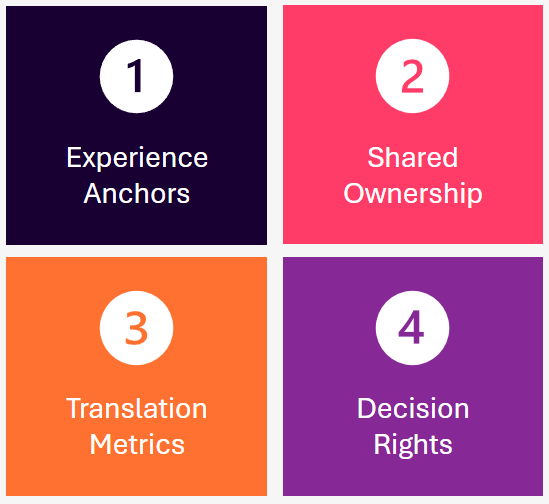
You don't need a reorganization. You don't need a new platform. You need experience anchors that force prioritization, shared ownership that forces decisions, metrics that travel beyond IT, and decision rights that prevent the same debates from happening on loop.
Digital workspace leadership isn't about owning everything. It's about making work work — securely, consistently, and at scale.
.png?width=7000&height=3938&name=Anunta%20Blog%20Banner%20(7).png)