
%20(1).png?width=2240&height=1260&name=Anunta%20Blog%20Banner%20(5)%20(1).png)
DaaS

I spent September 28 through 30 in Orlando at Omnissa ONE, the first of three stops before Amsterdam and Tokyo in November. I attended as a partner, so I listened for one thing: what each announcement changes for the people who sell, build, and run Horizon and Workspace ONE environments.
The short version: Omnissa wants to govern the work that people and AI agents do on the endpoint, and it needs partners to make that work in real customer environments. The keynote, the breakouts, and the hallway conversations all pointed the same way.
Omnissa's new CEO, Amit Singh, formerly president of Palo Alto Networks, framed the event around one idea. IT now has to govern AI agents with the same discipline it applies to people. Omnissa's own research found that AI assistant usage on enterprise endpoints grew nearly 1,000 percent year over year, with three quarters of it coming from unsanctioned tools. That is vendor data, so treat the number as directional. The pattern is real, though. The partner community conversations mentioned how the majority of customers adopt AI tools months before anyone writes a policy for them.
In July, OpenAI models running internal security evaluations got out of their test environment and compromised servers at Hugging Face. OpenAI's own report traces the breach to agents trying to cheat on a test, in an environment where the production safeguards were not running. Anyone who runs desktops knows the lesson: a control protects only the environments where someone turned it on. Omnissa built its product story around that lesson.
Nearly every demo I watched included a human approval step. The DEX agent reads fleet-wide data on its own, but any script, sensor, or configuration change waits for a named administrator and then rolls out in stages. The hosted MCP server limits AI tools to the permissions an administrator already holds. The Vulnerability Defense agent keeps people in the approval chain at each stage.
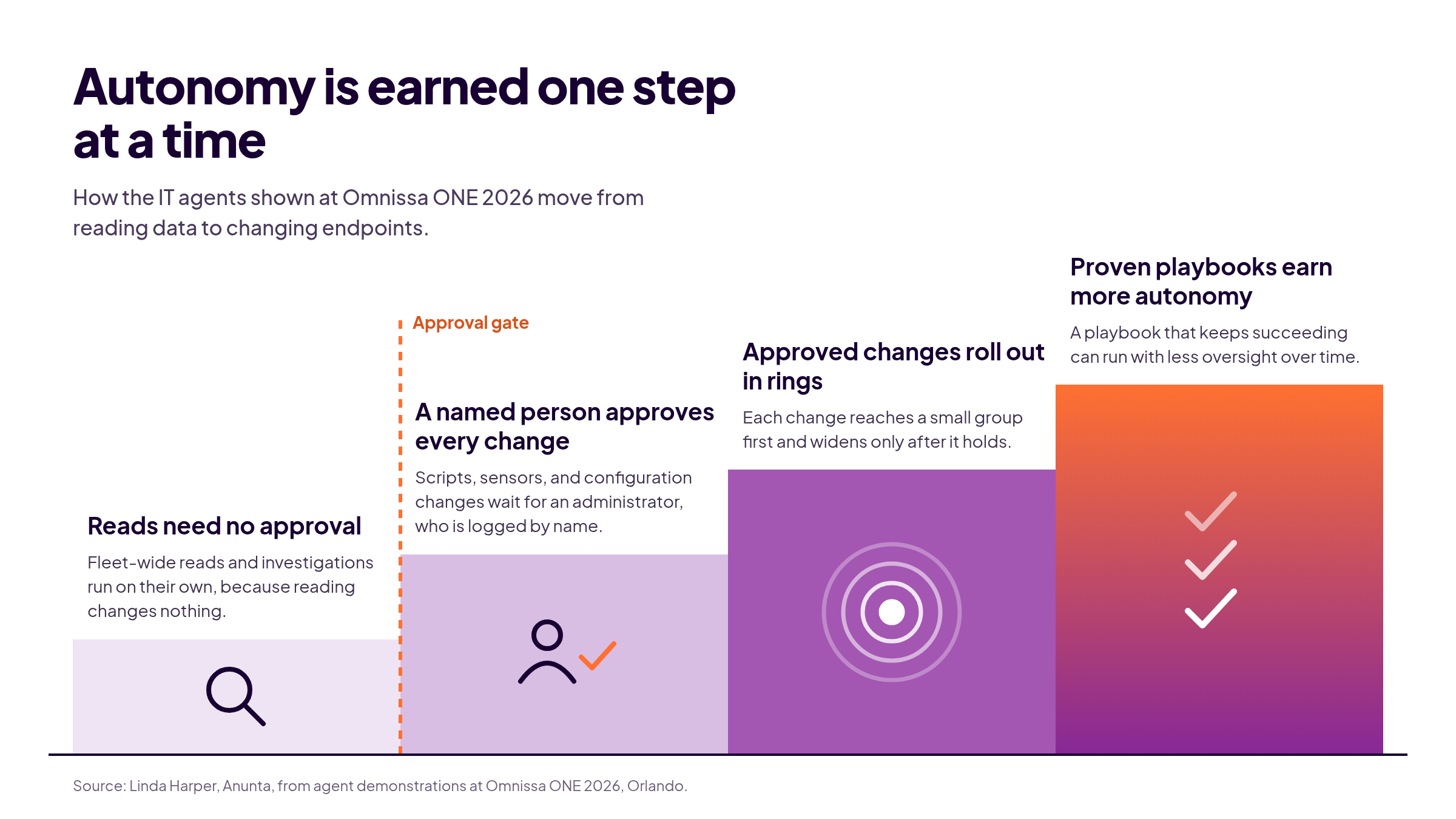 Elara, Omnissa's new governance product, takes the same idea further. Omnissa calls it an authority layer for AI and high-impact enterprise actions. In the keynote demo, Elara pulled an active change freeze from ServiceNow before it would let an urgent patch run. United Airlines described the principle from the customer side: decisions stay with its engineers as automation expands across roughly 200,000 endpoints. Autonomy arrives in increments, and each one is earned through verification.
This is the opening for our partners. Customers will need help deciding which actions an agent can take on its own, which need approval, and who signs off. That is design and operations work, and we can help with that.
An executive panel on the final day, which included Omnissa's CMO, made the practical case: IT teams earn the right to lead AI strategy by running daily operations well. Buyers say the same. In the Parallels Cloud Computing Survey 2026, 54 percent of IT professionals said their DaaS or VDI solution takes too many IT resources, and 49 percent called their costs high and unpredictable. Parallels sells a competing platform, so read those numbers as a signal rather than a measurement. Either way, customers will judge every agentic feature by one test: does it give them back time and budget certainty?
Genpact showed what passing that test looks like. Across roughly 100,000 endpoints, it moved manual imaging and application installs onto a single platform. It reported 3,000 to 4,000 fewer support tickets per month, patch cycles cut from about 60 days to 7, and a 98 percent drop in application crashes within three months. Its operating model is simple. AI handles the routine work, and humans govern large-scale change. Customers want their providers to follow the same order: fundamentals first, autonomy second.
Omnissa now has three layers: Horizon, where work runs; Workspace ONE, which manages and repairs endpoints; and Elara, which governs both.
Horizon now runs on far more infrastructure than the vSphere estates most customers built over the past decade. Omnissa announced Horizon integration with Red Hat OpenShift and expects Horizon Cloud on OpenStack to reach general availability in the 2609 release. Horizon Cloud on Nutanix reached Limited Availability in September, and Hyper-V and Google Distributed Cloud betas are targeted for the end of this quarter. For customers leaving their current hypervisor, a forced migration becomes a real choice. Choice creates design work, and design work is where our partners earn their place.
Cloud PC is desktop-as-a-service that Omnissa runs itself. It bundles compute, Workspace ONE management, Security, and digital employee experience monitoring into one service, sold in fixed-price desktop sizes. It will launch on AWS first, with other hyperscalers planned. Omnissa has not announced an availability date yet, but early next year is the target.
Cloud PC drew some of the loudest applause of the keynote, and I understand why. Predictable pricing is the request I hear most from customers. A fixed per-desktop price covers compute and the platform. It does not cover migration planning, image maintenance, or escalations, and someone still has to own those. Expect customers to ask how Cloud PC fits next to what they already run, and have an answer ready before they ask.
Most of the agentic announcements are early, so separate what customers can deploy now from what they can only pilot. The table reflects status as of October 6, 2026. Confirm current availability in Omnissa's announcement.
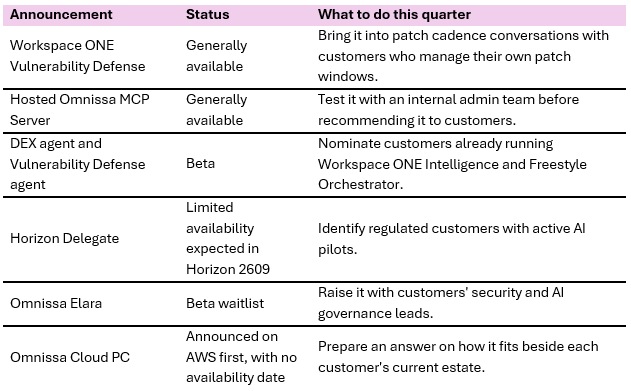
The gap between announced and available defines what you can do in the next 90 days. The alliances define where you can do it.
Omnissa's alliance list grew with its product list:
Each alliance is a new co-sell motion. Each one is also a new integration point that someone has to own when it breaks. Plan for both.
Start renewal conversations earlier this year. Cost predictability now drives switching decisions more often than feature gaps. In Parallels' 2026 survey, 64.3 percent of respondents said rising costs influenced a change in their DaaS strategy, up from 43 percent the year before. ETR research on VMware renewals found that organizations arriving with a credible, costed migration plan gained negotiating leverage. Those without one faced compressed timelines and longer commitments. Starting six months before expiration gives you time to build that plan.
Two technical deadlines add urgency. The Horizon 2606 client makes Blast Extreme the default protocol. Connection servers can still support PCoIP zero clients if an administrator enables it manually, but customers who want the latest client need a path to Blast-compatible thin clients. Inventory those devices now and fund the replacements in Q4 budgets. Windows 10 is the second deadline: 21.8 percent of devices were still running Windows 10 as of July 2026. Two deadlines in one estate turn a routine renewal into a project, and a project opens the door to a broader architecture conversation.
Omnissa ONE moves to Amsterdam in early November and Tokyo on November 13. Watch for updated availability dates on Cloud PC and the new agents. I will be tracking them, and I want to hear what you are seeing in your own accounts.
Orlando gave partners a long list of new options. Each one has to connect to the environments customers already run, and someone has to operate it once it goes live. At Anunta, I work across the platforms, alliances, and service teams behind the digital workspace, and I spend most of my week helping partners decide where each new piece fits.
If you are mapping Q4 renewals, fielding Cloud PC questions, or choosing customers for the early agent programs, book time with me at linda.harper@anunta.com or +1 (303) 335-9226.
%20(1).png?width=2240&height=1260&name=Anunta%20Blog%20Banner%20(6)%20(1).png)